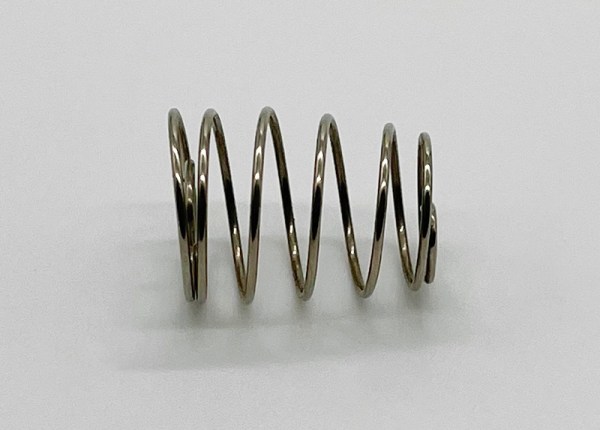
A compression spring is a helical spring that withstands axial pressure. It can withstand pressure, and its ends can be open, closed, wound flat, or ground flat. The cross-sectional materials used are mostly circular, with rectangular and multi-strand steel wire also being common. The springs can have either constant or variable pitch.
The shapes of compression springs include cylindrical, conical, convex, concave, and a small number of non-circular forms and various variants of tail ends, all of which can be formed according to product design requirements. There is a certain gap between the coils of the compression spring, and when an external load is applied, the spring contracts and deforms, storing deformation energy.
Compression springs are hardware components formed in a helical geometry by wire, so hardening and strengthening operations are more challenging compared to flat hardware components (such as stamped parts). In addition, the hardening effect on the cross-sectional area of compression springs must be strictly controlled to fully understand the fatigue resistance after use.
The hardening of pressure springs is generally achieved through two methods: shot peening and heat treatment.
The shot peening process for compression springs involves treating a batch of pressure springs by individually transporting them on a conveyor belt to the shot peening chamber, which contains a series of parallel rollers. While undergoing reinforcement, the springs roll and rotate forward, allowing high-velocity shot streams to pass through the gaps between the coils and impact the inner surfaces of the coils, where stress is concentrated. Shot peening is an effective strengthening method for suspension springs, and properly treated high-stress springs can achieve fatigue life improvements of over four times.
-
Tower Spring Price
The tower spring is a type of damping spring, characterized mainly by its small size, high load capacity,...
-
Shrapnel Wholesale Price
The manufacturing materials for shrapnel sheets generally should possess high elastic limits, fatigue limits, impact toughness, and good...